
Guidelines
Author Guidelines
Download STATEMENT OF NON-PLAGIARISM
Title Contains the Summary of the Findings, Written in English Maximum 18 Words and Times News Roman. Title Written With the First Letter of Each Word Is Written in Capital Letters, Except for Conjunctions That Are Located in the Middle of the Title
(Spasi 1, Font 14, Bold, Centre)
There is no need to write down the research location
Author Name1* (10pt), Author Name2 (10 pt), Author Name3 DST (10 pt)
(The full written name is listed below the article title without the main author's academic title written first)
1Affiliation A, City, State/Province, Country (9 pt)
2Affiliation B, City, State/Province, Country (9 pt)
3Affiliation C, City, State/Province, Country (9 pt)
(write the name of the University/Poltekkes/Institution; if there is more than one author from different institutions, write different lines. If the authors come from the same institution, no coding will be given) (9 pt)
Institution corresponding author email (format italic) (9 pt)
Artikel history
Received: Date-Month-Year (9pt)
Revised : Date-Month-Year (9pt)
Accepted: Date-Month-Year (9pt)
Published: Date-Month-Year (9pt)
ABSTRACT
The English abstract contains the introduction, objectives, methods, results and conclusions, written in one paragraph of a maximum of 250 words. Written in time news roman font format, 9 pt, spaced 1, italic, and right and left aligned.
Keywords: 3-5 words or combination of words
INTRODUCTION (10pt)
Manuscripts are written in Times New Roman in either British or American English. Authors can use A4 paper for the layout, ensuring it has a top-bottom margin of 3.5 cm, a right-left margin of 2 cm, 10 points, two columns, and a 1.5 space density. The author must submit the manuscript as a typed file in Microsoft Word, using the provided template. The OJS JKep (Jurnal Keperawatan) receives typed manuscripts via the URL link https://ejurnal.poltekkesjakarta3.ac.id/index.php/JKep. Although there is no restriction on the number of paragraphs, the contents must contain the background information, the research's goal, its position concerning earlier research endeavors, and the novelty of the research activities conducted. Creating a distinct sub-chapter for a brief theoretical underpinning directly relevant to the article's content is not necessary. The sentence concludes with citations numbered sequentially in the text's order.
METHODS (10pt)
The approach includes the design, size, criteria, sample technique, tools used, and methods for data collection, processing, and analysis. The population, sample, and sampling techniques are clearly stated, with detailed information provided regarding inclusion and exclusion criteria. When using a questionnaire as a tool, briefly describe its contents and the factors it aims to measure. Instrument validity and reliability should also be described. Interventional procedures or treatments are administered in experimental or intervention investigations that require explanation. This section should detail the protection of respondents' rights and the acquisition of ethical approval (include the link of etchical approvement) for the study. It is not necessary to write down the specifics of the software if it is not original while analyzing data with computer programs. The location of the study is solely relevant to the study itself. If only as a study site, the specifics of the location are not important and are just given in general terms, such as "... at a hospital in Jakarta." For the qualitative research, please explain how the study maintains the validity (trustworthiness) of the data obtained.
RESULTS (10pt)
The results at least contain two things, namely: (1) description, (2) interpretation (explanation) of the results of research activities. The results section is a unit containing an explanation of the results of the analysis related to the objectives. Tables, pictures, or illustrations are written according to the serial number of appearance in the text and given a short title (the title of the table or picture is 10 pt), and maximum table is 7 . The font size in the table can be reduced up to 10pt font and 1 space density.
Example:
Table 1. Respondent characteristic……...(10pt)
|
Variable |
Frequency (n) |
Percentage (%) |
|
x |
10 |
11.1 |
|
y |
30 |
33.3 |
|
z |
50 |
55.6 |
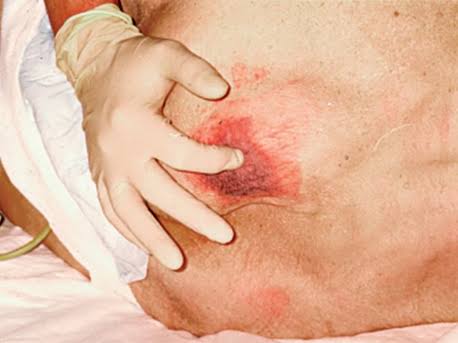
Figure 1. Decubitus
DISCUSSION (10pt)
Interpret the findings without repeating the Results section. Explain the principal findings, compare them with relevant evidence, discuss plausible explanations, identify strengths and limitations, and describe implications for health research, policy, education, or practice. Recommended discussion include: Principal Findings, Comparison With Existing Evidence, Strengths and Limitations, Implications for Research, Policy, Education, or Practice
CONCLUSION (10pt)
Conclusions made in one paragraph without citation contain conclusions and suggestions for further research activities.
DECLARATION (10pt)
Please also complete the DECLARATIONS section before the References, including:
Author Contributions: a brief description of each author’s contribution to the study and manuscript
Conflicts of Interest: disclosure of any financial, personal, professional, or institutional conflicts, or a statement that none exist.
Declaration of Generative AI and AI-Assisted Technologies: disclosure of any AI or AI-assisted tools used during manuscript preparation and their purpose.
Source of Funding: details of the funding institution and grant number, if applicable, or a statement that no specific funding was received.
Ethical Approval and Informed Consent: information on ethical approval and informed consent, where applicable. Acknowledgments: recognition of individuals or institutions that supported the study but do not meet authorship criteria.
Please ensure that all declaration statements accurately reflect the actual conditions of the study and manuscript preparation.
REFERENCES (10pt)
The references used, as much as possible, are the latest references published in the last ten years (minimum 75% of at least 15 references). The bibliography is written in chronological order with the serial number Imperial College London (numerical/Vancouver) and is recommended to use reference management applications such as EndNote, Mendeley, Zotero, and other applications. Plagiarism Similarity: Below 25%.
Example:
Journal article:
- Sanadgol N, Miraki Feriz A, Lisboa SF, Joca SRL. Putative role of glial cells in treatment resistance depression: An updated critical literation review and evaluation of single-nuclei transcriptomics data. Life Sci [Internet]. 2023 Oct 15 [cited 2024 Jul 30];331. Available from: https://pubmed.ncbi.nlm.nih.gov/37574044/. doi: 10.1016/j.lfs.2023.122025.
- Nopa I, Kurniawidjaja LM, Erwandi D. Coping Strategies for Nurses’ Distress in Dealing with the COVID-19 Pandemic: A Scoping Review. J Keperawatan Indones. 2024;27(1):12–24. doi:10.7454/jki.v27i1.1097
Organization website:
- The Top 10 Causes of Death [Internet]. 2024 [cited 2024 Nov 12]. Available from: https://www.who.int/news-room/fact-sheets/detail/the-top-10-causes-of-deathZahiruddin W, Ariesta A, Salamah E. Characteristics of Quality and Solubility Kitosan From Head of Shrimp (Penaeus Monodon) Silase Dregs. Jurnal Pengolahan Hasil Perikanan Indonesia. 2008;11(2):25-9. doi:10.17844/jphpi.v11i2.917
Book:
- Ahmad B, Putra DA. Panduan Menulis Karya Ilmiah, 2nd ed. Jakarta: Penerbit Ilmiah Nusantara; 2023. Seri 5, Volume 10. Tersedia di: https://www.penerbitilmiahnusantara.com/panduan-menulis.
Official Document:
- Kementerian Kesehatan Republik Indonesia. Panduan Praktik Keperawatan Klinis. Jakarta: Kemenkes RI; 2019.
Conference Proceeding:
- Suryani A, Rahmawati D. Efektivitas intervensi keperawatan dalam menurunkan kecemasan pasien preoperatif. Dalam: Arifin H, Supriyadi S, editor. Prosiding Seminar Nasional Keperawatan. Surakarta: Universitas Muhammadiyah Surakarta; 2022. p. 45-52.
Report:
- Mahendra DM. Asuhan Keperawatan pada Pasien Post Operatif Apendisitis di RSUD Dr. Kanujoso Djatiwibowo Balikpapan Tahun 2021. Samarinda: Poltekkes Kaltim; 2021.